

2026 Top Lithium Battery Inverter Types for Global Buyers
The 2026 Top Lithium Battery Inverter Types for Global Buyers guide arrives as storage moves from a niche technology toward everyday energy infrastructure. The International Energy Agency’s Batteries and Secure Energy Transitions report estimates that global energy storage capacity must increase sixfold by 2030, reaching approximately 1,500 GW in its net-zero pathway. That expansion will place greater pressure on inverter efficiency, thermal control, battery communication, and grid compatibility.
Lazard’s Levelized Cost of Storage analysis also shows why buyers are examining lithium-based systems more closely. Costs continue to improve, but installation conditions, financing, cycling patterns, and replacement assumptions can change the final result. A low-cost inverter may look attractive on a quotation sheet. It may perform poorly in a hot, dusty warehouse. Details matter.
Günther Cramer, founder of SMA Solar Technology and a pioneer in power conversion, once said, “The inverter is the heart of a photovoltaic system.” His observation remains relevant for modern battery systems, although lithium storage adds stricter requirements for battery management and safety coordination. This guide compares hybrid, off-grid, grid-tied, and three-phase Lithium Battery Inverter types for international buyers. It considers practical issues, including voltage ranges, backup switching, certification, monitoring, and service access. Yet no ranking is universal. A model that works beautifully in a European home may disappoint in a remote African microgrid. That uncomfortable point deserves attention. Performance depends on the complete system, not the inverter label alone.
What Is a Lithium Battery Inverter?
2026 Top Lithium Battery Inverter Types for Global Buyers
What Is a Lithium Battery Inverter?
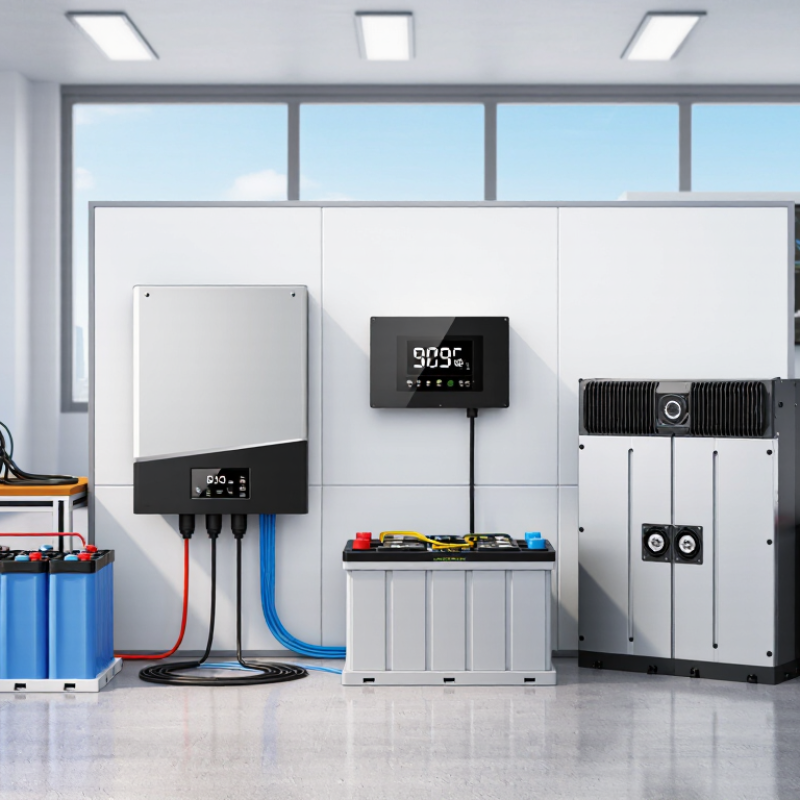
A lithium battery inverter converts stored direct current into usable alternating current for homes, businesses, and microgrids. It also reverses this process during charging. Modern units coordinate with the battery management system, monitor temperature, and limit unsafe current levels. In practical installations, this communication matters as much as conversion efficiency. A high-efficiency inverter cannot compensate for poor battery data.
The main types include grid-tied, off-grid, and hybrid inverters. Grid-tied models work with utility power and renewable generation. Off-grid units support remote loads through batteries and backup generators. Hybrid inverters combine solar input, battery storage, and grid control in one enclosure.
Some systems use modular power-conversion equipment instead. That design can simplify expansion, but it may increase commissioning work.
Demand is growing quickly. The International Energy Agency reported that global battery storage additions in the power sector increased by more than 130% in 2023, reaching about 42 GW. Its 2024 Batteries and Secure Energy Transitions report also identifies storage as essential for integrating expanding renewable generation.
These figures explain the market’s attention. Still, labels can mislead. “Lithium inverter” does not guarantee compatibility with every lithium battery. Buyers should verify voltage range, continuous power, surge capacity, communication protocol, thermal protection, and local grid requirements.
The difficult part is often not choosing the largest unit. It is matching the inverter to real loads, climate, and installation skills. Mistakes happen.
How Lithium Battery Inverters Work with Battery Management Systems
2026 Top Lithium Battery Inverter Types for Global Buyers
Lithium battery inverters convert stored direct current into usable alternating current. The battery management system, or BMS, controls the safety conversation between both devices. It measures cell voltage, pack temperature, charge current, and discharge current. It also estimates the state of charge, although this value can drift over time.
A compatible inverter receives BMS data through CAN or RS485 communication. When a cell reaches its voltage limit, the BMS can request lower charging power. If temperature rises near the permitted range, it may stop charging or discharging. The inverter should follow these commands quickly. A suitable system also displays fault codes, communication status, and remaining capacity on its monitoring screen.
Field testing often reveals small differences between specifications and actual behavior. A battery may show 30% capacity during cold weather, yet deliver less energy under heavy loads. Conservative inverter settings improve protection but can reduce usable capacity. Communication may also fail after a cable is damaged or configured incorrectly. In that situation, some inverters enter a limited fallback mode, while others shut down completely. Buyers should check protocol compatibility, maximum current, operating temperature, and firmware support before installation. An installer should verify voltage readings with calibrated equipment and test charging, backup transfer, and emergency shutdown functions. Small checks matter.
The Main Lithium Battery Inverter Types in 2026
Lithium battery inverters now serve different energy layouts, not one universal application. The main types include grid-tied, off-grid, hybrid, AC-coupled, and DC-coupled models. Each type manages battery charging, solar production, and household loads differently. The distinction matters.
Grid-tied inverters prioritize utility synchronization and usually shut down during outages unless battery backup is integrated. Off-grid inverters create an independent electrical network for cabins, remote facilities, and backup systems. Hybrid inverters combine solar, battery storage, and grid input through one control platform. In practice, this can reduce wiring, but installation settings become more demanding.
AC-coupled systems add a battery inverter beside an existing solar inverter. They suit retrofit projects where replacing working equipment would be wasteful. DC-coupled systems connect solar panels and batteries on the direct-current side, often reducing conversion losses. However, they require careful voltage matching and compatible charge controls. Check the data sheet.
In 2026, buyers should examine continuous output, surge capacity, battery voltage range, MPPT limits, cooling design, and BMS communication. A 5 kW inverter may not support a pump or compressor during startup. Lithium batteries also need approved protection logic, temperature monitoring, and clear shutdown behavior. The categories overlap, which can confuse buyers. A neat classification is useful, but never perfect. Installer skill, local grid rules, cable length, and future battery expansion can change the better choice.
How Inverter Types Differ in Power, Efficiency, and Grid Support
For global buyers, lithium battery inverters differ less by appearance than by power behavior. Grid-tied inverters usually deliver steady output, while hybrid inverters balance solar generation, battery charging, backup loads, and grid exchange. Off-grid models must manage sudden motor starts, cloudy weather, and limited battery reserves. A 5 kW inverter may run lighting easily, yet struggle with a 3 kW pump’s starting surge.
Efficiency is not a single number. NREL’s 2024 Annual Technology Baseline uses approximately 85% round-trip efficiency for utility-scale battery storage, before site-specific losses. Cable length, temperature, standby consumption, and conversion settings can reduce real performance. A useful field check is simple: compare energy entering the battery with energy later delivered to loads. The result may disappoint.
Grid support adds another distinction. Advanced hybrid inverters can provide frequency response, voltage support, ramp-rate control, and demand shifting. The IEA’s 2024 Batteries and Secure Energy Transitions report indicates global battery storage could grow from about 86 GW in 2023 to 1,200 GW by 2030 under its net-zero pathway. That growth requires inverters capable of fast, stable communication with grid controls. However, not every inverter supports every local grid code. Buyers should verify reactive-power capability, response time, islanding protection, and certified operating ranges. Datasheets often look clearer than installations are.
| 2026 Top Lithium Battery Inverter Types for Global Buyers - How Inverter Types Differ in Power, Efficiency, and Grid Support | |||||||||
|---|---|---|---|---|---|---|---|---|---|
| Inverter Type | Typical System Power | Typical Peak Efficiency | Battery Connection | Grid Support Capability | Backup Operation | Conversion Path | Best-Fit Applications | Main Advantages | Key Limitations |
| Grid-Tied Battery Inverter | 3–10 kW residential; 10–250 kW commercial | 95–98% | Usually DC-coupled to a lithium battery; some models use high-voltage battery packs | Advanced models may provide reactive power control, active-power limitation, frequency response, and voltage support | Optional; requires an automatic transfer device or backup gateway | DC battery to AC loads or grid | Solar-plus-storage systems where grid connection is available | High conversion efficiency; effective peak-shaving and time-of-use energy shifting | Normally shuts down during a grid outage unless backup hardware and anti-islanding functions are installed |
| Hybrid Solar Inverter | 3–15 kW residential; 15–100 kW small commercial | 94–98% | Typically direct DC connection to lithium batteries, with integrated solar MPPT inputs | Can support export limiting, demand management, voltage control, and programmable charging; capability depends on local grid codes | Yes, when equipped with an EPS or backup output and correctly sized battery capacity | Solar DC and battery DC are managed before conversion to AC | New residential solar-storage installations and small commercial sites | One device can manage PV generation, battery charging, grid exchange, and backup loads | More complex commissioning; battery voltage, communication, and grid certification must be compatible |
| Off-Grid Battery Inverter | 1–8 kW residential; 8–100 kW modular systems | 90–96% | Direct battery connection, commonly paired with solar charge controllers or integrated MPPT inputs | Not intended to provide public-grid ancillary services; may manage a generator or microgrid bus | Built in; creates and regulates a local AC network without a utility grid | Battery DC to stable local AC; solar and generator inputs may be managed separately | Remote homes, telecom sites, agricultural facilities, and isolated microgrids | Reliable standalone operation and strong control of local voltage and frequency | Requires accurate load and battery sizing; no direct utility export without additional equipment |
| AC-Coupled Battery Inverter | 3–10 kW residential; 10–500 kW commercial | 92–96% battery round-trip path | Connected on the AC side of an existing PV inverter | Can provide demand response, peak shaving, export control, frequency-watt response, and reactive power if certified | Possible with a grid-forming model and transfer equipment; not universal | Existing PV inverter AC to battery DC, then battery DC back to AC | Retrofit storage for operating solar installations | Easy to add to existing PV systems without replacing the solar inverter | Additional AC-to-DC and DC-to-AC conversions can reduce total round-trip efficiency |
| DC-Coupled Battery Inverter | 3–15 kW residential; 50 kW–1 MW utility-scale blocks | 94–98% from PV DC to battery or inverter DC bus | Battery shares a DC bus with PV through a hybrid inverter or bidirectional DC converter | Strong control of solar curtailment, ramp rate, active power, reactive power, and battery dispatch when grid-certified | Available in systems designed with grid-forming capability and critical-load separation | PV DC and battery DC share a common DC conversion stage before AC export | New solar farms, high-utilization commercial systems, and utility-scale storage | Fewer conversion steps for solar charging; efficient capture of clipped PV energy | Less suitable for simple retrofits; system design and DC protection requirements are more demanding |
| Three-Phase Battery Inverter | 10–50 kW commercial; 50 kW–1 MW and above for larger systems | 95–98% | AC-coupled or DC-coupled, depending on system architecture | Suitable for three-phase balancing, power-factor control, voltage support, ramp-rate control, and demand management when approved | Available for selected critical-load or microgrid configurations | Bidirectional three-phase AC and DC battery conversion | Factories, warehouses, commercial buildings, farms, and distributed energy resources | Handles balanced three-phase loads and higher continuous power with lower current per phase | Higher installation complexity; protection, phase balance, and grid interconnection rules require professional design |
| Data note: Values are typical engineering ranges for lithium-battery energy-storage systems. Actual power, efficiency, backup behavior, and grid-support functions vary by topology, battery voltage, ambient temperature, operating load, certification, and local interconnection requirements. Peak efficiency is not the same as full-system round-trip efficiency. | |||||||||
How Global Buyers Can Choose the Right Lithium Battery Inverter
Global buyers should match an inverter type to daily energy patterns, not brochure ratings. A hybrid inverter suits homes with solar, battery storage, and unstable grid supply. An off-grid model fits remote sites, but it needs a generator or larger battery reserve. Grid-interactive units can export power, subject to local connection requirements. Small detail, big consequence. Check whether the inverter supports the battery’s nominal voltage and maximum charge current. Reliable BMS communication also improves charging control and fault protection.
In practical commissioning, peak loads often decide success. A refrigerator may start at several times its running wattage. A pump, workshop tool, or air conditioner can create the same problem. Compare continuous output, surge capacity, and allowable overload time. My first sizing estimate was too optimistic; startup demand exposed the mistake. Leave headroom, even when the budget feels tight. Also check efficiency at partial load, because many systems run below peak power.
For global purchasing, inspect temperature range, enclosure rating, warranty terms, and service access. A tropical installation may need ventilation and corrosion protection. A cold warehouse may require battery heating or restricted charging. Ask for test reports, wiring diagrams, firmware update procedures, and spare-part availability. Certification should match the destination market and installation environment. Do not choose only by the lowest price. Yet the most expensive inverter is not automatically the safest choice. Review installer skill, replacement time, and real maintenance conditions before committing. That last check is often neglected.
2026 Top Lithium Battery Inverter Types for Global Buyers
Typical Peak Conversion Efficiency by Inverter Type
For global buyers, grid-tied and high-voltage hybrid inverters generally provide the highest peak conversion efficiency, while off-grid and backup inverters prioritize resilience, surge handling, and operation during grid outages.
Values represent typical peak DC-to-AC conversion-efficiency levels found across current residential and small commercial lithium battery inverter specifications. Actual efficiency depends on load level, battery voltage, temperature, operating mode, and installation design.
Related Posts
-
Top 10 Lithium Battery Inverter Manufacturers from China at the 137th Canton Fair
-
Why Choose a Lithium Ion Battery Pack for Your Needs?
-
Unwavering Quality of Best Lithium Iron Batteries from Trusted Chinese Manufacturers
-

Unlocking the Future of Energy with Innovative Lithium Cell Technology
-
5 Unexpected Benefits of Lithium Battery Storage You Need to Know
-

Top 10 Solar System Batteries for Global Buyers in 2026?