

2026 Top Rotary Desiccant Dehumidifier Types for Buyers
Choosing a rotary desiccant dehumidifier is not just a matter of comparing rated capacity. Buyers need to match wheel design, desiccant material, airflow, and regeneration heat to the actual moisture load. A warehouse protecting hygroscopic materials may need a different setup from a battery room or a food-production line. Small details matter: inlet temperature, seasonal humidity, exhaust routing, and the space available for service access. Get those wrong, and even a capable unit can disappoint.
C. R. C. Harriman III, author of The Dehumidification Handbook, provides a useful buying principle, paraphrased here: “Choose for the moisture load, not the brochure.” That is easy to overlook. Buyers can compare standard silica-gel wheels, high-performance low-dew-point designs, and compact packaged systems, but labels alone do not settle the decision. Ask for performance data at your expected operating conditions, not only a peak-capacity figure. Check energy use, controls, filter access, and the practical cost of replacing or servicing the wheel. A careful review also considers whether the system can handle changing loads without excessive regeneration heat. No single type fits every site. Some published specifications leave important assumptions unclear, so request them in writing. This guide introduces the main rotary desiccant dehumidifier types and the trade-offs buyers should examine before choosing.
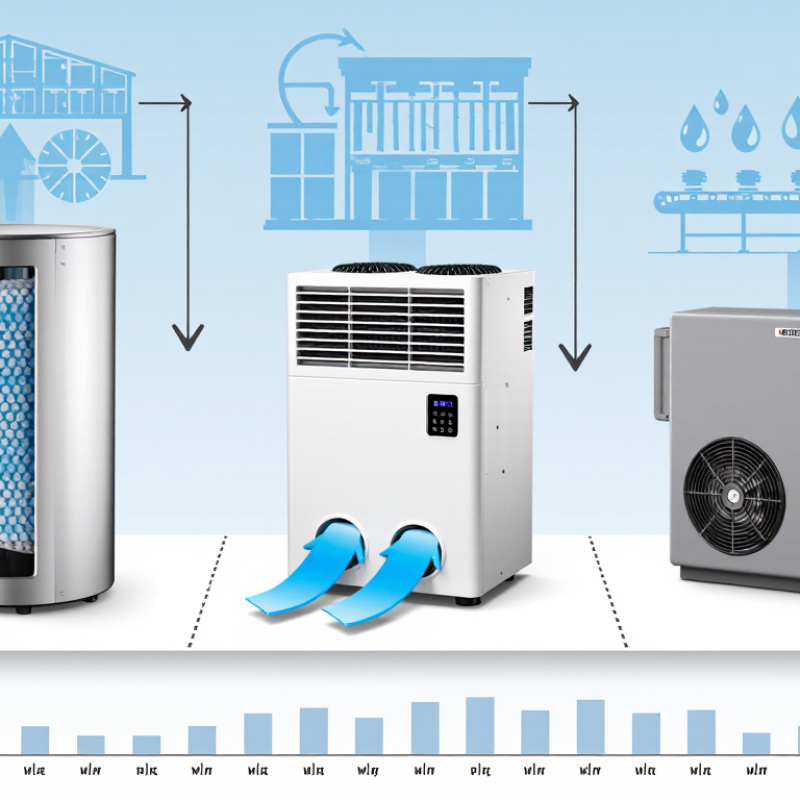
How Rotary Desiccant Dehumidifiers Work: Process and Reactivation Airflows
A rotary desiccant dehumidifier uses a slowly turning honeycomb wheel coated with moisture-attracting material. Damp process air crosses one sector; the desiccant captures water vapor, and drier air leaves the wheel. The wheel keeps moving. Moisture does not disappear, though—it must be driven off elsewhere.
A separate, heated regeneration-air stream passes through the other sector and releases the stored moisture outdoors. A common wheel layout assigns roughly 75% of its face to process air and 25% to regeneration; actual proportions depend on the application and equipment design (ASHRAE Handbook—HVAC Systems and Equipment, 2024). That split is not a universal airflow specification. Buyers should check the equipment’s rated airflow, inlet conditions, and regeneration temperature together.
Watch the ducts, too. Process and regeneration streams need to remain separated, or humid exhaust can leak back into the dry-air path. Small leakage matters. The ASHRAE handbook’s desiccant guidance explains the importance of airflow arrangement and regeneration conditions, but a catalog rating cannot predict every installation. A cold warehouse, for example, may need different controls from a warm packaging room. Actual site measurements are worth the effort; designs can miss their target.
Compare Silica Gel, Molecular Sieve, and Composite Desiccant Wheels
2026 Top Rotary Desiccant Dehumidifier Types for Buyers
Silica gel wheels suit many general drying applications. Their porous surface captures water vapor, and regeneration releases it into a separate exhaust airstream. In practical selection, check the required outlet dew point, airflow, and regeneration temperature—not just the desiccant name. Silica gel often offers a useful balance. But performance can fall when seals leak or the wheel becomes contaminated.
Molecular sieve wheels have tightly controlled pores and can perform well when very low humidity is required. They may be appropriate for sensitive production or storage areas. The trade-off is higher regeneration demand in some operating conditions, so compare energy use at the design airflow. Very dry air, indeed. A quoted dew point alone does not tell you how much heat the system will consume.
Composite wheels combine desiccant materials, often to broaden operating performance. Their actual behavior depends on composition, coating quality, and how evenly the wheel regenerates. Ask for test data under conditions close to your own; a sample result from a different temperature or humidity may mislead. I would not choose from a material label alone. Inspect the wheel’s seals, check maintenance access, and confirm whether the supplier’s performance figures include pressure drop and regeneration airflow. One detail is easy to miss: the best material on paper may not suit a plant’s available heat source.
Classify Standard, Low-Dew-Point, and Hybrid Rotary Systems
2026 Top Rotary Desiccant Dehumidifier Types for Buyers
Standard rotary systems suit warehouses, process rooms, and general humidity control. A rotating desiccant wheel absorbs moisture from process air, while heated regeneration air dries the wheel. Low-dew-point systems use deeper regeneration and tighter airflow control for battery rooms, pharmaceutical production, or dry storage. ASHRAE’s 2024 Handbook of HVAC Systems and Equipment describes desiccant dehumidification for demanding moisture-control applications; engineered rotary systems can reach dew points near −40°F (−40°C). That figure is a design capability, not a guaranteed result. Wheel material, inlet conditions, and regeneration heat all matter.
Hybrid systems combine a desiccant wheel with cooling equipment. The cooling stage can remove sensible heat, while the wheel handles latent moisture. This arrangement may reduce overcooling, but added controls and equipment raise commissioning demands. A common buying mistake is comparing units by airflow alone. Check moisture-removal capacity at your actual entering temperature and humidity, then verify regeneration energy and outlet dew point. Specifications can look tidy; site conditions rarely do.
Tips: Request performance data at your design conditions, including regeneration temperature, airflow, and measured dew point. Ask for a commissioning test. Small leaks can undermine the result.
Compare 60–200°C Regeneration Needs and Dew-Point Targets Down to −40°C
A rotary desiccant wheel’s regeneration temperature shapes both moisture capacity and energy use. A 60–90°C heat source may suit moderate drying loads, while deeper drying often needs hotter regeneration or a larger wheel. ASHRAE’s Handbook—HVAC Systems and Equipment discusses regeneration conditions as application-dependent; 60–200°C is a buyer’s comparison range, not a universal operating requirement. Check the supplier’s rated inlet temperature, airflow, and outlet dew point together. One number is not enough.
For very dry air, ask whether the quoted target is atmospheric dew point or pressure dew point. ISO 8573-1 defines compressed-air water Class 2 at a pressure dew point of −40°C or lower. That benchmark does not automatically describe a room-air dehumidifier. A −40°C process target may require dry inlet air, adequate purge, and stable wheel sealing. Small leaks matter. Compare performance at the actual inlet humidity and process airflow, then confirm it under seasonal conditions. A warmer regeneration source can reduce energy demand, but may not maintain the target during humid startup. That trade-off deserves testing, not assumption.
Select by Airflow, Moisture Load, Energy Use, and Maintenance Requirements
For a rotary desiccant dehumidifier, start with the moisture load, not the catalogue’s largest airflow figure. Estimate water removal in kilograms per hour from the wettest operating condition, then check process airflow and target outlet dew point. ASHRAE’s 2024 Handbook—HVAC Systems and Equipment explains that wheel performance depends on both process and regeneration conditions. A wheel that moves plenty of air may still miss a low-dew-point target.
Energy needs a closer look. Regeneration heat can dominate operating costs, so compare heat source, temperature requirements, fan power, and expected annual hours—not just rated capacity. UNEP and GlobalABC’s 2023 Global Status Report reports that buildings use 34% of global energy demand. That figure is not specific to dehumidifiers, but it is a useful reminder to include HVAC energy in equipment decisions. Ask suppliers for performance data at your actual inlet temperature and humidity. Test the assumptions.
Maintenance affects real output. Check access to the wheel, seals, filters, drive system, and regeneration heater; dusty intake air can quickly raise pressure drop. For continuous operation, confirm how alarms and wheel-speed adjustments are handled. A practical selection may trade peak capacity for stable control and easier servicing. That trade-off deserves scrutiny.###
| Type | Typical Process Airflow* | Moisture Load & Best Fit | Energy Use Considerations | Maintenance Requirements | Buyer Selection Note |
|---|---|---|---|---|---|
| Compact packaged unit Typically a silica-gel rotor | About 100–1,000 m³/h | Low to moderate load; small rooms, cabinets, laboratories, and localized storage areas. | Usually electrically heated regeneration; total use depends on airflow, inlet humidity, set point, and heater controls. | Check and replace air filters as needed; inspect seals, rotor drive, and drain or condensate components where fitted. | Good where installation space and straightforward controls matter more than large capacity. |
| Standard industrial unit Commonly silica-gel rotor | About 500–10,000 m³/h | Moderate to high load; production areas, warehouses, and process spaces requiring controlled humidity. | Regeneration heat is a major energy input. Compare electrical and thermal demand at the same design conditions; heat source and recovery options can change operating cost. | Plan for routine filter service and inspection of rotor rotation, seals, drive components, and regeneration-air temperature. | A versatile choice when airflow and humidity targets are clearly defined and a suitable heat source is available. |
| High-capacity modular system Multiple sections or rotors | About 5,000–50,000+ m³/h, depending on configuration | High or variable load; large facilities, centralized process systems, and multiple air-handling zones. | Fans and regeneration heating can require substantial energy. Evaluate part-load control, pressure drop, heat recovery, and the facility’s available utilities. | Requires planned access for filters, rotor and drive inspections, duct checks, and controls maintenance; service needs grow with system size. | Use a load calculation and zone-by-zone airflow schedule; confirm redundancy and turndown requirements before sizing. |
| Low-dew-point system Often configured with molecular-sieve media or a combined rotor arrangement | About 100–10,000 m³/h; application-specific | High-dryness applications such as battery-material handling, pharmaceutical processes, or moisture-sensitive manufacturing. | Very low outlet dew points may require more regeneration energy and careful control. Compare performance at the specified inlet state and outlet dew point. | Keep process air clean and prevent moisture bypass; inspect filters, rotor seals, and dew-point sensors according to the operating plan. | Specify the required dew point and allowable variation, not just relative humidity; verify performance under the actual process conditions. |
| Hybrid cooling-and-desiccant system | About 500–20,000 m³/h; system design dependent | Moderate to high latent load where both temperature and humidity need control. | Cooling and desiccant stages share the load. Actual savings depend on climate, operating schedule, heat-recovery design, and control sequence. | In addition to rotor and filter checks, maintain cooling coils, condensate drainage, sensors, and related refrigeration or chilled-water components. | Consider when a conventional cooling-only system struggles to meet humidity targets without overcooling or reheating. |
| Low-temperature regeneration configuration Designed for compatible rotor media and heat sources | About 500–20,000 m³/h; application-specific | Moderate load where low-grade waste heat or hot water is available and the required outlet dryness is compatible with the design. | May use recovered or lower-temperature heat, but performance depends on heat-source temperature, flow, and operating conditions. Confirm backup heating needs. | Routine rotor, filter, seal, and sensor checks; also verify heat-exchanger cleanliness and stable regeneration-air conditions. | Choose only after confirming the heat source is available when dehumidification is required and the supplier’s performance guarantee matches the design point. |
*Airflow ranges are indicative market-level selection ranges, not guaranteed ratings; products and configurations vary. Moisture-removal capacity cannot be reliably inferred from airflow alone: request performance data at the project’s inlet temperature and humidity, required outlet condition, and regeneration-air conditions. Compare energy using the same test point, including both electrical input and regeneration heat, and follow the equipment manufacturer’s maintenance schedule.