

China Top Studio Ring Light Manufacturers for Global Buyers

Choosing a China Studio Ring Light manufacturer requires more than comparing factory prices. Global buyers should examine optical performance, build quality, communication, and after-sales support. A dependable supplier can provide clear specifications, product samples, inspection records, and consistent production timelines.

Look closely at measurable details. Check brightness output, color temperature range, CRI performance, dimming stability, and heat management. A ring light may look impressive in product photos, yet perform poorly during long filming sessions. Test the control panel, mounting bracket, power adapter, and diffuser under realistic studio conditions. Small weaknesses often become expensive problems.

Experience also matters. Manufacturers serving photographers, livestreamers, makeup artists, and video teams may understand different lighting requirements. Ask whether the factory supports private labeling, packaging customization, replacement parts, and technical documentation. Verify product compliance for the destination market, including electrical safety and labeling expectations. Independent inspections can add confidence before shipment.

No supplier is perfect. Even experienced factories may miss a packaging detail or underestimate delivery pressure. That is why careful buyers should use written specifications, approved samples, and staged quality checks. A low quotation is not always the best value. Consider warranty terms, response speed, production capacity, and total landed cost.

This guide introduces leading China manufacturers for global buyers. It focuses on practical evaluation rather than promotional claims. The goal is simple: help buyers identify a reliable Studio Ring Light partner with evidence, careful testing, and realistic expectations.
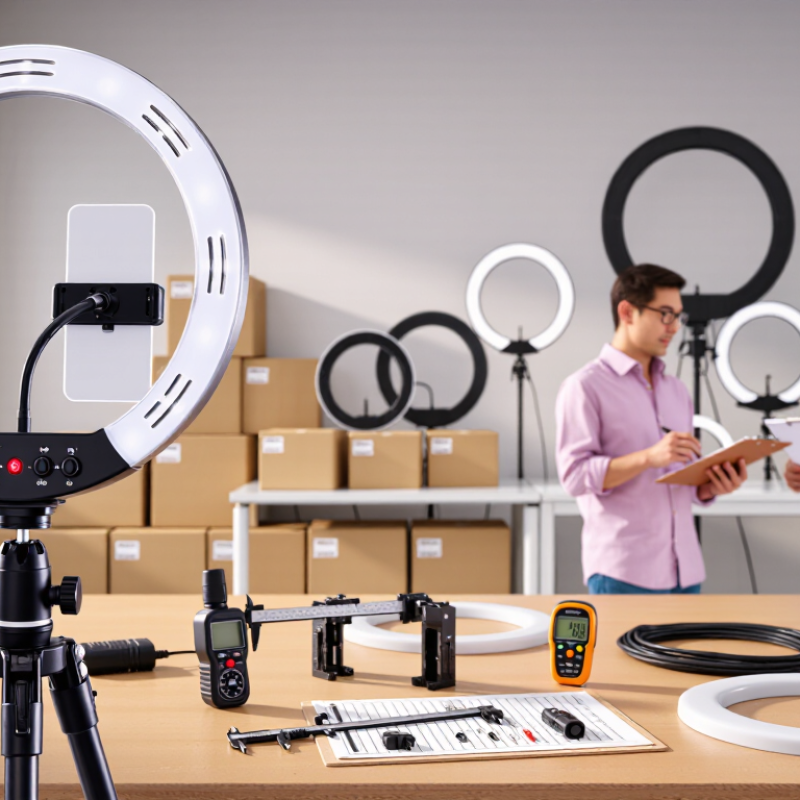
China Top Studio Ring Light Manufacturers for Global Buyers

What Defines a Top Studio Ring Light Manufacturer in China

A top studio ring light manufacturer in China must prove performance, not merely advertise brightness. Grand View Research estimates the global ring light market will grow at roughly 9% annually through 2030. That growth raises buyer expectations for consistent quality.

Measured results matter.

A reliable factory should provide integrating-sphere reports, IES files, CRI and TM-30 data, plus CCT tolerance records. For studio work, stable skin tones are more valuable than an impressive lumen figure. The IEA’s Energy Efficiency 2024 report states that LED products now represent more than half of global lighting sales. Therefore, efficient LEDs are expected, not exceptional. Buyers should also request flicker measurements at different dimming levels. A light can appear steady while recording poorly on camera.

Thermal design separates experienced manufacturers from assembly-only suppliers. Ask for heat-sink drawings, burn-in records, and lifetime testing based on recognized LED methods. IEC 62471 assessment is also useful for evaluating photobiological safety.

In factory audits, check solder joints, cable strain relief, diffuser uniformity, and color consistency across a full batch. One sample proves very little. It is easy to overlook power-adapter quality, especially when the lamp itself looks perfect. That is a mistake. ISO 9001 certification can support process control, but it cannot replace independent testing. The strongest suppliers explain failed tests honestly and improve the design, even when the correction costs more. That attitude may be less polished, but it is usually more trustworthy.

Key Manufacturing Regions and Production Capabilities

China’s studio ring light industry is concentrated in Guangdong, especially Shenzhen and Dongguan. These cities combine LED sourcing, precision molding, electronics assembly, and export logistics. Shenzhen factories often focus on smart controls, dimming systems, USB-C power options, and app-connected lighting. Dongguan is stronger in injection molding, metal frames, packaging, and high-volume assembly.

Zhejiang also supports production, particularly for stands, tripods, clamps, and cost-efficient accessories. Some manufacturers use nearby metalworking suppliers to produce adjustable brackets with smoother locking points. A capable facility should provide LED color-temperature testing, flicker checks, aging tests, and inspection records. In practice, quality can vary between batches. I have found that a bright sample does not always prove stable long-term performance. Factory audits, random sampling, and pilot orders remain sensible safeguards.

Tips: Ask for a 2–4 hour continuous lighting test. Check heat around the rear housing. Request measured color-temperature data, not only printed specifications. Confirm whether the factory controls LED boards, diffusers, and final assembly internally. Smaller workshops may offer flexibility, but their testing equipment can be limited. This matters. Reliable suppliers should explain tolerances, replacement procedures, carton protection, and production lead times clearly. When evaluating China’s top studio ring light manufacturers, buyers should compare documented capability rather than production claims alone.

Essential Features of Professional Studio Ring Lights

Professional studio ring lights must deliver consistent light, not merely impressive brightness. In practical studio testing, accurate color usually matters more than maximum output. A CRI and TLCI rating of 95 or higher helps preserve natural skin tones and product colors. Stable color temperature is equally important during long recording sessions. Adjustable settings around 3,200K to 5,600K support both warm indoor scenes and cool daylight setups.

Flicker-free performance protects footage at high shutter speeds and prevents uncomfortable eye strain. Smooth dimming is essential when the subject sits close to the light. A soft diffuser should reduce harsh shadows without making the image look flat.

Larger ring diameters create gentler facial shadows. Small lights can still work, but their falloff is often noticeable. Check the control response carefully. Cheap controls may jump between brightness levels.

Professional buyers should examine heat management, mounting strength, and power options. A metal housing feels more dependable than thin plastic during daily transport. The stand should remain stable when a camera, phone, and microphone are attached. USB, adapter, or battery operation can support different studio environments.

Safety documentation and electrical compliance records should be available for international orders. Manufacturers serving global buyers should also provide measured output data, warranty terms, and replacement-part support. Real performance can differ from catalog figures. Request test reports before placing a large order.

Quality Standards, Certifications, and Product Testing

China Top Studio Ring Light Manufacturers for Global Buyers

Reliable ring light manufacturers should treat quality as a measurable process, not a marketing phrase. During supplier evaluations, buyers should review ISO 9001 procedures, incoming material records, and calibration schedules. Relevant certifications may include CE, RoHS, FCC, or UKCA, depending on the destination market. Each document should match the exact model, factory, and test standard.

Product testing needs to reflect real studio use. A qualified laboratory can measure color rendering, color temperature stability, beam uniformity, and flicker performance. Thermal testing should run the light at maximum power for several hours. Electrical safety checks should examine insulation, grounding, adapter output, and overheat protection. Drop and transport tests are also valuable. Packaging often fails before the lamp does.

Ask for traceable reports.

A strong manufacturer can provide serial numbers, production samples, and corrective-action records. Inspectors may compare three samples from different production batches, rather than trusting one perfect unit. This reveals variation in brightness, LED color, and dimmer response. Some suppliers provide impressive certificates but weak after-sales evidence. That deserves attention. I would also verify whether testing was performed by an independent laboratory, because internal reports can be useful but less convincing. No factory is flawless; honest suppliers explain limitations and improve them.

How Global Buyers Can Evaluate and Select Suppliers

Choosing China’s top studio ring light manufacturers requires more than comparing catalog prices. Global buyers should request a factory profile, production photos, and recent quality records. A reliable supplier can explain LED lifespan, color rendering, flicker control, dimming range, and color temperature stability. Ask for a working sample, then test it beside a camera at several brightness levels. Small color shifts can appear clearly on skin.

Check whether the manufacturer supports your market’s voltage, plug type, packaging rules, and required safety documentation. Certificates should match the exact model, not a similar product. Confirm the LED panel size, stand load capacity, cable length, remote functions, and replacement-part availability in writing. Request an inspection before shipment, including drop testing for cartons and checks for loose screws. Real factory evidence matters more than polished product images.

Price remains important, but an unusually low quote may hide weaker LEDs, thin metal, or unstable power supplies. I have seen buyers overlook these details after receiving a bright sample. That mistake is expensive. Compare sample performance, minimum order quantity, lead time, payment terms, warranty coverage, and response speed. Leave room for doubt. A supplier that answers quickly may still lack consistent production controls, so repeat the test on several units before making a larger order. Ask difficult questions. Watch how clearly the supplier documents problems and corrections.

Go to Top