

How to Choose the Best Barbed Wire Making Machine?

Choosing the right Barbed Wire Making Machine requires more than comparing prices or reading speed claims. The machine must match your wire material, production goals, workspace, and quality expectations. A reliable supplier should explain these details clearly. Vague promises are a warning sign.

Start with the finished product. Will you produce standard galvanized fencing wire, stainless steel wire, or another approved material? Wire diameter, barb spacing, and coil size affect machine selection. For example, a factory making 2.5-millimeter galvanized wire may need different tooling from a workshop producing lighter fencing products. Small details matter.

They matter a lot.

Consider the machine’s forming method, motor capacity, control system, and adjustment range. A practical machine should maintain consistent tension while twisting the wire. Uneven barbs can create waste, customer complaints, and difficult inspection. Ask for production samples, not only catalog photographs. Experienced manufacturers should provide technical drawings, test records, installation guidance, and spare-parts information.

Safety also deserves serious attention. Look for enclosed transmission parts, emergency-stop controls, stable frames, and clear operating instructions. Operators need training before handling rotating equipment or sharp finished wire. Workplace ventilation, noise control, and routine maintenance should be reviewed as well. Compliance requirements differ by location, so confirm applicable industrial and electrical standards with qualified local professionals.

A cheaper machine may appear attractive at first. However, weak components can increase downtime and repair costs. No machine is perfect. Even a well-designed model needs cleaning, lubrication, inspection, and occasional adjustment. The best choice balances output, durability, operator safety, after-sales support, and long-term operating value. That balanced evaluation is the foundation for a dependable purchase.
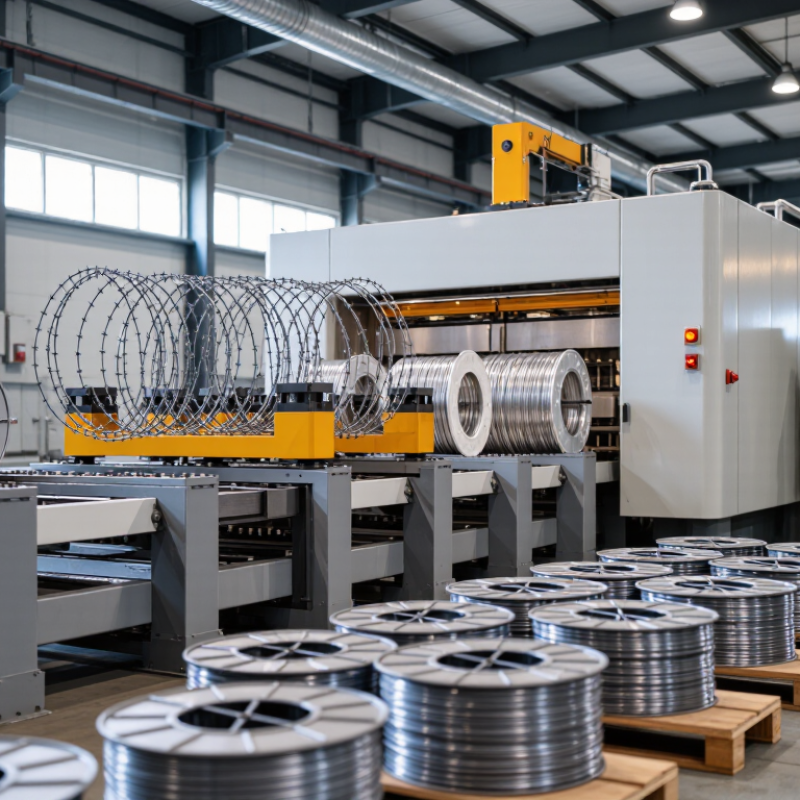
How to Choose the Best Barbed Wire Making Machine?

Machine Types and Their Barbed Wire Production Methods

Choosing a barbed wire making machine starts with its production method, not its advertised speed. A single-twist machine wraps two line wires around one another, then forms barbs at fixed intervals. It suits standard galvanized fencing and simpler maintenance. A double-twist machine adds stronger interlocking, which can improve stability on long fence runs. Reverse-twist models create opposing twists and resist unraveling after cutting.

High-speed automatic machines usually combine wire straightening, feeding, barb forming, twisting, cutting, and coil collection. Semi-automatic machines separate some of these steps. They cost less, but require more operator control. A 2024 report from Grand View Research identified galvanized wire as the leading material segment in the global barbed wire market. This supports choosing corrosion-resistant processing equipment for outdoor production. Still, market demand does not guarantee machine suitability.

Tips: Check wire diameter, barb spacing, coil weight, and output before buying. Match the machine to ASTM A121 requirements where applicable. Ask for a real production trial, not only a catalog video. Measure noise, wire breakage, and actual hourly output. In my experience, quoted capacity often assumes ideal wire and nonstop feeding. That assumption needs questioning. A small workshop may prefer a stable semi-automatic line, while a high-volume plant may justify automatic take-up and tension control. Leave room for imperfect coils. That detail is often ignored.

How to Choose the Best Barbed Wire Making Machine? - Machine Types and Their Barbed Wire Production Methods

Machine Type Barbed Wire Production Method Typical Wire Structure Common Production Capacity Suitable Wire Diameter Automation Level Main Advantages Best Application
Single-Twist Barbed Wire Machine
Two line wires are twisted together while the barbs are inserted at regular intervals during the twisting process. Usually two longitudinal wires with two-wire barbs. Approximately 40–80 kg/h, depending on wire diameter, barb spacing, and machine configuration. Commonly about 1.6–2.8 mm for line wire. Medium
Automatic twisting and barb feeding; manual coil loading and unloading may be required.
Relatively simple construction, moderate investment, easy maintenance, and suitable for standard fencing products. Small and medium production lines, agricultural fencing, boundary fencing, and general-purpose security fencing.
Double-Twist Barbed Wire Machine
Two line wires are twisted together, and the barbs are formed from separate wire pieces and locked into the twisted strands. Typically two line wires with two- or four-point barbs. Approximately 60–120 kg/h, depending on the number of strands and operating speed. Commonly about 1.6–3.0 mm for line wire and 1.6–2.5 mm for barb wire. High
Continuous wire feeding, twisting, barb forming, and length control.
Higher output than many single-twist designs, consistent barb spacing, and strong resistance to barb displacement. Medium and large fencing factories producing galvanized or coated barbed wire in continuous batches.
Four-Strand Barbed Wire Machine
Four line wires are twisted into a denser structure while barbs are inserted and secured at predetermined intervals. Four longitudinal wires with two- or four-point barbs. Approximately 80–150 kg/h, depending on material and product specification. Commonly about 1.8–3.0 mm for line wire. High
Designed for continuous production with automatic tension and feeding control.
Dense construction, high mechanical strength, and improved resistance to cutting and pulling. High-security fencing, restricted-area barriers, infrastructure protection, and heavy-duty agricultural applications.
Reverse-Twist Barbed Wire Machine
Two line wires are twisted in opposite directions at successive sections, helping prevent the wire from unraveling when cut. Commonly two line wires with two-point barbs and a reverse-twist pattern. Approximately 50–100 kg/h, depending on wire size and twist configuration. Commonly about 1.6–2.8 mm for line wire. High
Requires synchronized twisting units and controlled barb positioning.
Better structural stability, improved anti-unraveling performance, and consistent appearance. Security fencing, perimeter protection, correctional facilities, and applications requiring enhanced tamper resistance.
High-Speed Automatic Barbed Wire Line
Integrated line wire pay-off, straightening, tension control, twisting, barb forming, cutting, winding, and coil collection. Usually two- or four-strand products, based on interchangeable tooling. Approximately 100–250 kg/h; actual output varies with product type and operating conditions. Commonly about 1.6–3.0 mm for line wire and 1.6–2.5 mm for barb wire. Very High
Programmable control, automatic fault detection, synchronized drives, and automated coil handling.
High productivity, reduced labor requirements, repeatable product quality, and efficient long-run operation. Large-scale production, export-oriented manufacturing, and facilities with continuous demand for standardized coils.
Manual or Semi-Automatic Barbed Wire Machine
The operator loads wire, adjusts the barb positions, and assists with coil winding while the machine performs the main twisting operation. Mostly two line wires with standard two-point barbs. Approximately 20–60 kg/h, depending on operator skill and machine settings. Commonly about 1.6–2.5 mm for line wire. Low to Medium
Manual loading, adjustment, and product handling.
Lower initial cost, straightforward operation, flexible for small batches, and easier to install. Start-up operations, workshops, rural fencing suppliers, and businesses with limited production volume.
PVC-Coated Barbed Wire Production Line
Galvanized or low-carbon steel wire is twisted and barbed, followed by plastic coating through an extrusion or coating unit. Two- or four-strand steel core with a polymer outer layer; barb tips may be coated or left exposed. Approximately 40–150 kg/h for the complete line, depending on coating thickness and cooling capacity. Commonly about 1.8–3.0 mm steel core diameter before coating. High
Requires coordinated wire making, coating, cooling, take-up, and temperature control.
Improved corrosion resistance, colored appearance, longer service life, and reduced handling risk. Coastal regions, landscaping, residential boundaries, and projects requiring colored or weather-resistant fencing.
Galvanized Barbed Wire Machine
Steel wire is processed into barbed wire and supplied as galvanized wire, or the finished product is galvanized in a separate treatment line. Two- or four-strand barbed wire with a zinc-protected steel surface. Approximately 50–150 kg/h for the wire-making stage; galvanizing capacity depends on the separate coating line. Commonly about 1.6–3.0 mm for line wire. Medium to High
Wire-making automation is separate from the galvanizing process when coating is performed upstream or downstream.
Good corrosion resistance, broad market acceptance, and suitability for outdoor use. Agricultural fencing, highway boundaries, industrial sites, and general outdoor security applications.

Note: Production capacities are typical planning ranges rather than guaranteed outputs. Actual performance depends on wire material, tensile strength, wire diameter, barb spacing, coil size, machine configuration, operator skill, and maintenance conditions.

Key Specifications for Comparing Barbed Wire Making Machines

How to Choose the Best Barbed Wire Making Machine?

Comparing key specifications is more reliable than judging a machine by appearance. Start with the supported wire diameter range. A suitable machine should handle your required wire sizes without frequent adjustments. Check the barb spacing and twisting accuracy as well. Uneven spacing can reduce product quality and increase material waste.

Line speed matters, but it should not be considered alone. Ask whether the stated speed applies to continuous production or ideal test conditions. A stable output is often more valuable than maximum speed. Examine the feeding system, motor power, and tension control. These features influence wire alignment and reduce sudden breaks during operation. Inspect the control panel, emergency stop, guarding, and automatic shutdown functions. Safety details are specifications too.

Look closely at power consumption and floor space. A compact machine may fit your workshop, but limited access can make maintenance difficult. Check the coil capacity, lubrication points, replacement parts, and adjustment time. Operators should be able to change settings without complicated procedures. Request sample testing with your actual wire and barb requirements. Paper specifications can be incomplete. A machine may perform differently after several hours of continuous work. Also review noise levels, vibration, and the manufacturer’s technical documentation. Reliable support should include clear manuals, training, and measurable service response times. Do not ignore small issues. They often become expensive later.

How to Choose the Best Barbed Wire Making Machine?

Key Specifications for Comparing Barbed Wire Making Machines

Representative production benchmark: Machine output generally decreases as the wire diameter increases. Typical non-branded machines process approximately 1.6–3.0 mm wire, operate at about 30–60 m/min, deliver around 40–100 kg/h, and use motors in the 2.2–4.0 kW range.

When comparing machines, check whether the stated capacity matches your target wire diameter, production speed, motor power, automatic wire feeding system, finished coil size, and adjustment requirements.

Material Compatibility and Finished Wire Quality

How to Choose the Best Barbed Wire Making Machine?

Material Compatibility and Finished Wire Quality

Material selection should guide your machine choice. In my experience, galvanized low-carbon steel behaves differently from stainless steel. Each material needs suitable wire diameter settings, forming pressure, and tension control. A machine may process several materials, but that does not guarantee equal results. Ask for tested production samples before making a decision.

Low-quality dies can leave scratches, flattened sections, or uneven barbs. These defects often appear after continuous production, not during a short demonstration. Check whether the machine maintains stable tension as the coil becomes smaller. The finished wire should have consistent spacing, sharp but secure barbs, and a smooth surface. Look closely at the zinc coating. It should not flake around the twisted areas.

Measure the wire diameter with a calibrated micrometer. Check barb spacing across several meters, not just one section. A simple pull test can reveal weak twisting or loose joints. Also inspect the coil shape and winding density. Poor winding may create feeding problems during installation. Do not rely only on the machine’s rated capacity. I once overlooked die wear during an evaluation, and the final coils showed subtle quality changes. That mistake was expensive. Request maintenance records, replacement-part details, and a real production trial using your intended material.

Production Capacity, Automation, and Operating Efficiency

How to Choose the Best Barbed Wire Making Machine?

Production Capacity, Automation, and Operating Efficiency

Choosing a barbed wire making machine starts with realistic production needs. Check the required wire diameter, barb spacing, coil weight, and daily output. A machine rated for high speed may underperform with thicker wire or frequent size changes. Ask for measured output, not only catalog figures. In practical trials, stable tension often matters more than maximum speed. Inspect the forming unit, twisting system, and take-up device. These parts should produce even twists and consistent barbs across a full coil.

Automation can reduce manual adjustments and improve repeatability. Look for automatic wire feeding, length control, tension monitoring, and fault alerts. Simple controls are valuable when operators work several shifts. However, excessive automation may increase maintenance difficulty. A clear control panel and accessible components are often more useful than complicated features. Operating efficiency also depends on setup time, power consumption, spare-part access, and cleaning requirements. A faster line is not always a better line. I would compare output per operator, not speed alone.

Tips: Request a sample run using your actual wire material. Measure output, coil weight, noise, and adjustment time. Check emergency stops and guarding before purchase. Speak with experienced operators, not only sales staff. Leave room for training; even a reliable machine can lose efficiency through poor setup. Keep records for the first month, because early assumptions are often wrong.

Safety, Maintenance, Cost, and Supplier Evaluation

How to Choose the Best Barbed Wire Making Machine?

Safety, Maintenance, Cost, and Supplier Evaluation

Safety should guide every machine decision. Check guarding, emergency stops, wire tension controls, and electrical protection before discussing output. Operators should see clear warning labels and reach controls without crossing moving parts. A short trial run can reveal vibration, exposed pinch points, or unstable feeding. Do not trust a polished brochure alone.

Maintenance affects production more than many buyers expect. Inspect the cutting unit, twisting mechanism, bearings, and lubrication points during a supplier demonstration. Ask how quickly common parts can be replaced and whether technical instructions are clear. I have seen machines lose hours because a small guide roller was difficult to adjust. That detail was easy to miss.

Cost requires a wider view. Compare purchase price, power use, spare parts, training, installation, and expected downtime. A lower quotation may become expensive after repeated adjustments. Request written capacity data using your wire diameter, coating type, and working schedule. Supplier evaluation should include factory experience, testing records, warranty terms, response time, and references from similar operations. Ask difficult questions. Reliable suppliers should answer with evidence, not pressure. I would also budget for operator training, although this is often underestimated. Even experienced teams can make mistakes during the first production week.

Go to Top