How to Find a Reliable Kitchen Faucet Accessories OEM?
A dependable Kitchen Faucet Accessories Oem can influence more than purchase price. It affects fit, finish, replacement-part availability, and the daily feel of a kitchen. Small parts matter. A loose pull-down hose weight or rough-edged soap dispenser can undermine an otherwise well-made faucet. For buyers comparing suppliers, the key question is not simply who offers the lowest quote. It is who can repeat the same quality across samples, production runs, and delivery schedules.
Industry research helps explain why careful sourcing matters. The NKBA 2024 Kitchen Trends Report and Houzz’s 2024 U.S. Kitchen Trends Study track changing kitchen priorities and renovation choices. Their findings offer useful context for evaluating finishes, practical features, and product consistency, rather than relying on supplier claims alone. Still, reports cannot inspect a factory for you. Ask for material specifications, dimensional drawings, sample approvals, quality-control records, and clear defect remedies. Check whether relevant materials meet applicable drinking-water requirements, such as NSF/ANSI 61 or 372, when those standards apply. Request evidence, not promises. A thoughtful OEM partner should explain its testing process, identify production limits, and respond clearly when a sample fails. Some buyers overlook communication until problems appear. That is an avoidable risk. This guide outlines practical ways to assess technical capability, manufacturing experience, quality systems, and long-term support before placing an order.
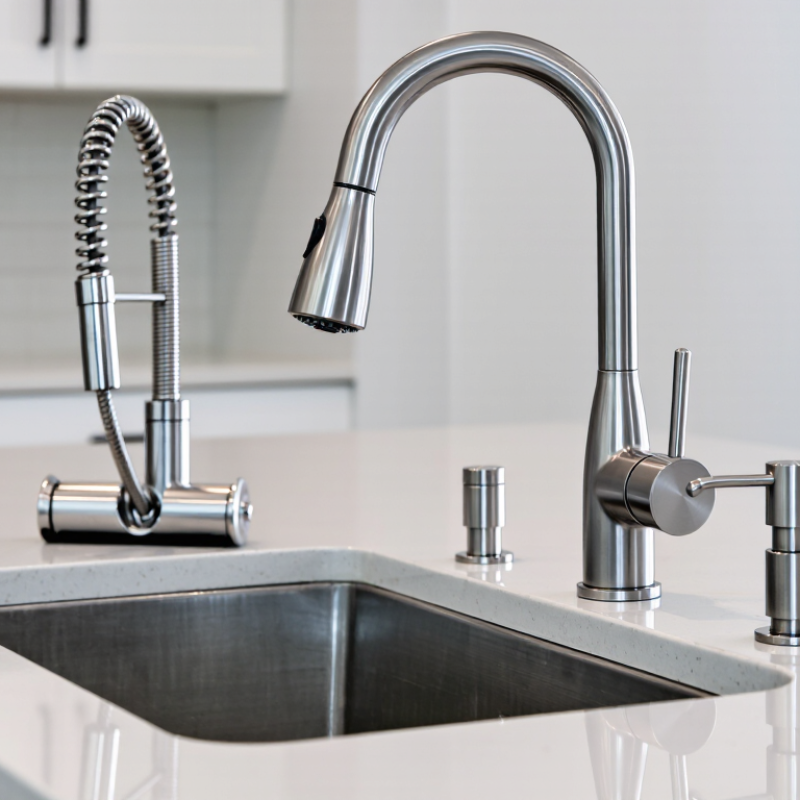
Define Your Kitchen Faucet Accessories OEM Requirements
Before contacting a kitchen faucet accessories OEM, turn your product idea into measurable requirements. List each component, such as pull-down sprayers, hose assemblies, aerators, and mounting hardware. Specify dimensions, connection types, materials, finish, target price, order volume, and intended market. Small details matter: a hose that is 5 centimeters too short can limit reach, while a mismatched thread can delay assembly.
Set performance expectations too. The U.S. Department of Energy’s federal standard limits kitchen faucets to 2.2 gallons per minute at 60 psi. Treat that as a design boundary, then define the flow rate and spray behavior your product needs. The Houzz 2024 U.S. Kitchen Trends Study surveyed 1,620 homeowners, offering useful context on active kitchen renovation demand; however, renovation interest does not automatically predict demand for a specific accessory. That distinction is easy to miss.
Ask potential OEM partners how they verify leak resistance, flow consistency, finish durability, and fit across production batches. Request sample inspection records and clarify who handles tooling, packaging, and changes after approval. Put acceptance criteria in writing. A polished sample is not enough. I have seen specifications leave the finish “standard,” which sounds clear until two production lots look different. Define the acceptable color range and inspection method before placing an order.
Assess Manufacturing Capabilities and Product Expertise
A reliable kitchen faucet accessories OEM should demonstrate repeatable manufacturing, not just present polished samples. Ask which processes happen in-house, from machining and molding to surface finishing and assembly. Review inspection records for dimensions, leakage, operating torque, and finish consistency. For hoses, cartridges, and connectors, request material specifications and compatibility evidence. Small details matter. A neat sample cannot reveal whether the next production run will match it.
Product expertise shows in how clearly the supplier explains design choices and trade-offs. Ask how it controls drawing revisions, component tolerances, and batch traceability. The U.S. EPA’s 2023 WaterSense Annual Report estimates that WaterSense-labeled products have saved 8.7 trillion gallons since the program began in 2006. This figure does not measure kitchen faucets specifically, but it highlights the wider value of efficient product design. Ask how the OEM balances water flow, sealing, and durability rather than treating each as a separate target.
A factory audit and pilot order can expose gaps that a catalog misses. Check whether test results identify the sample size, method, and acceptance criteria. Ask for examples of corrective actions after a failed inspection; a capable supplier should explain what changed. No process is flawless. A polished showroom sample can still hide inconsistent controls, so verify performance across multiple units before approving production.
Verify Quality Control Systems and Regulatory Compliance
A reliable kitchen faucet accessories OEM should be able to show how quality is checked, not just promise consistent production. Ask for written inspection procedures covering incoming brass or stainless-steel parts, machining, surface finishing, assembly, and final leak tests. Request recent records from actual production batches. A polished sample can look convincing, but it may not reflect every unit on the line. Check how the factory tracks defects and corrective actions, too.
Tips: Ask to see a filled inspection report, not only a blank form. Compare the sample’s finish, thread fit, and hose connections with the stated specifications. Small mismatches matter.
Regulatory compliance depends on where the accessories will be sold and what materials contact drinking water. Ask the OEM to identify applicable requirements and provide current test reports or certificates for the exact product and materials. Confirm that document names, model numbers, and test scope match your order. If a report covers only one component, it may not establish compliance for the full assembly. Third-party testing can add confidence, though it cannot guarantee that every production batch is identical. Factory visits and audits are useful, but imperfect snapshots; pair them with ongoing records, clear acceptance criteria, and occasional independent checks.
Compare Pricing, Lead Times, and Communication Practices
When comparing kitchen faucet accessories OEMs, request the same itemized quote from each supplier. Separate tooling, samples, packaging, inspection, and freight. A low unit price can hide expensive mold changes or unclear exclusions. Small details matter. Ask for written lead times for samples, production, and shipment, plus the assumptions behind each date. Deloitte’s 2023 Global Chief Procurement Officer Survey found that 72% of procurement leaders expected supply chain disruption to continue. That makes a supplier’s recovery plan worth checking, not just its best-case delivery promise.
Compare suppliers using the same order quantity and specification, then ask what could delay production: finish approvals, component shortages, or a rejected sample. UNCTAD’s Review of Maritime Transport 2024 reported that maritime trade grew 2.4% in 2023, while forecasting 2% growth for 2024. Those figures describe shipping, not faucet accessories, but they underline why factory and transit timelines should be discussed separately. Communication is part of the comparison. Send one technical question about a cartridge, hose, or surface finish, and note how clearly the OEM answers. Do they confirm tolerances, flag missing details, and share a dated update? A polished sales reply is not the same as dependable production communication. I would still verify these habits with a sample order; a spreadsheet cannot show how an unexpected delay is handled.
Evaluate Samples and Factory Audits Before Selecting an OEM
A reliable kitchen faucet accessories OEM should show more than a polished sample. Request production-intent parts, including hoses, aerators, sprayers, and mounting hardware. Check dimensions with calipers and confirm threads fit your faucet body. Run water through the sprayer, inspect the stream, and look for leaks at each connection. Small flaws matter. A stiff button or uneven finish may become a daily complaint.
Test samples under realistic conditions, not just on a clean showroom counter. Turn handles repeatedly, bend hoses, and check whether finishes scratch during ordinary handling. Ask how the sample compares with the materials and tooling used for mass production. In practice, a beautiful prototype can hide weak consistency. That is easy to miss.
A factory audit should verify the process behind the sample. Observe incoming material checks, assembly steps, and final inspection on the actual production floor. Ask to see inspection records, measurement tools, and examples of how defects were corrected. Check whether workers follow written procedures, rather than relying on verbal assurances. One limitation remains: a short visit cannot prove every batch will match. Request a pilot run and compare its parts with approved samples before placing a larger order.
How to Find a Reliable Kitchen Faucet Accessories OEM?
Evaluate samples and factory audits before selecting an OEM.
Example assessment ratings on a 1–5 scale, not industry statistics. Test product samples for leakage, flow, finish, and fit; audit the factory’s inspection records, material traceability, process controls, and corrective-action system. Verify ratings with documented evidence before making a decision.