

What Are Heavy Duty Sliding and Folding Doors?
Heavy-Duty Sliding & Folding Doors are designed to open wide while carrying substantial panels through repeated daily use. They can help connect a living room to a patio, or give a commercial space a broad, flexible entrance. The term “heavy-duty” is not a universal performance rating, though. Buyers should check panel weight limits, hardware specifications, weather seals, and installation requirements for the exact system.
Architect Louis Kahn famously said, “A room is not a room without natural light.” His observation offers a useful architectural lens: wide-opening doors can bring daylight deeper indoors and make the threshold feel less defined. But appearance is only part of the decision. A smooth glide depends on correctly sized tracks, rollers, hinges, and supports. Small installation errors can become noticeable when large panels move each day.
Sliding doors typically travel along tracks, while folding systems gather panels to one or both sides. Each layout has trade-offs. Tracks need attention, and folded panels occupy space near the opening. Not every system suits every building. Check the opening dimensions, exposure to wind and rain, access needs, and available clearance before choosing. A product label alone cannot confirm performance. The details matter.
This guide explains the basic designs, materials, hardware, and practical selection points. It also considers limitations, because oversized doors can be impressive—and demanding. For a reliable comparison, use manufacturer specifications and have a qualified installer assess the opening.
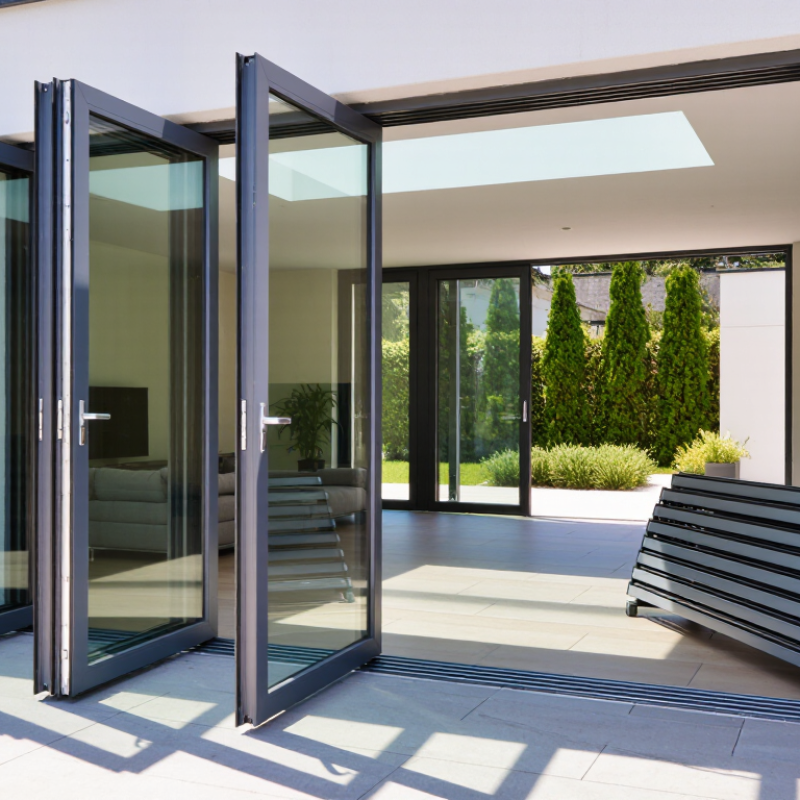
What Defines Heavy-Duty Sliding and Folding Doors?
Heavy-duty sliding and folding doors are defined by how their parts handle weight, movement, and repeated use—not by appearance alone. The frame must resist flexing, while tracks, rollers, hinges, and fasteners need to support the door’s size and operating demands. A wide sliding panel, for example, depends on a stable track and correctly sized rollers to move smoothly. Folding panels place added demands on hinges and connections between sections. Small components matter.
There is no single weight that makes a door “heavy-duty” in every setting. Daily opening frequency, panel width, exposure to wind, and the building structure all affect what is suitable. Look for clear load information and installation guidance, then match those details to the opening. A strong door fitted to an uneven frame can bind or wear prematurely. That part is easy to overlook. Track alignment, secure anchoring, and accessible maintenance points matter too. I would not judge durability by thick-looking metal alone; the full assembly and how it is installed tell a more useful story.
How Do Sliding and Folding Door Systems Support and Move Heavy Panels?
Heavy sliding and folding doors move through a chain of load-bearing parts. In a sliding system, rollers carry the panel along a level track, while hangers and brackets transfer its weight into the supporting structure. A floor guide controls sway; it should guide, not carry, the panel. Folding systems divide the load across linked hinges and carriers, so alignment matters at every joint. Small installation errors can make a heavy door drag or bind.
The EN 1527:2019 hardware classification includes declared door-mass categories and endurance testing of up to 100,000 operating cycles. This gives specifiers a useful basis for comparing hardware, but it does not guarantee smooth movement in every opening. Track deflection, uneven floors, dust, and frequent slamming still affect performance. The panel’s actual weight, width, and use frequency should inform hardware selection, not appearance alone.
Tips: Ask for the tested mass rating and cycle class. Check that the track support matches the building structure. Keep rollers clean, and inspect alignment when movement becomes uneven. A little resistance is easy to dismiss; it can signal a developing problem.
Which Materials and Hardware Determine a Door’s Load Capacity?
Heavy-duty sliding and folding doors are defined less by appearance than by the weight each panel and its hardware must carry. A wide glass leaf can weigh far more than a narrow timber one. Steel reinforcement, frame depth, glass thickness, and panel size all affect that load. Yet strong materials alone cannot prevent sagging.
Check the stated maximum panel mass, not just the total system capacity. Rollers, bearings, track, hinges, fixings, and the supporting wall must work together. EN 1527:2019 classifies sliding and folding hardware durability using cycle tests ranging from 5,000 to 100,000 cycles. That measures repeated operation, not a door’s safe load by itself. ASTM E330/E330M provides a test method for structural performance under uniform pressure; it does not set one universal capacity for every door. A detail that is easy to overlook: installation errors can undermine otherwise well-rated hardware.
Tips: Ask for a tested panel-weight rating and confirm whether it includes the glass. Check track fixing points and substrate strength. For unusually wide or heavy panels, request project-specific engineering. Ratings matter. Real support matters too.
What Are Heavy Duty Sliding and Folding Doors? — Which Materials and Hardware Determine a Door’s Load Capacity?
| Door or Component | Material or Construction | Relevant Fact | How It Affects Load Capacity | Selection Check |
|---|---|---|---|---|
| Sliding door leaf | Glass panel | Ordinary glass has a density of about 2,500 kg/m³. A 10 mm pane therefore weighs about 25 kg per square metre, before adding the frame and hardware. | Glass thickness and panel area contribute directly to the weight carried by the rollers and track. | Calculate the complete panel weight, including frame, handles, and fittings. Use safety glass where required by applicable building codes. |
| Sliding or folding door leaf | Timber | Timber density varies widely with species, moisture content, and construction. Solid timber, engineered timber, and hollow-core leaves can have substantially different weights. | The material name alone does not establish leaf weight; construction and dimensions matter. | Use the documented weight of the finished leaf rather than estimating from the surface material. |
| Framed door leaf | Aluminum | Aluminum has a density of about 2,700 kg/m³, but finished frame weight depends on profile shape, wall thickness, reinforcement, and glazing. | A suitably designed frame can support large glazed panels, but the assembled door still loads the track, rollers, or hinges. | Check the complete assembly weight and the frame maker’s permitted panel dimensions and infill. |
| Framed door leaf | Steel | Steel has a density of about 7,850 kg/m³. Thin formed profiles can be strong, but steel components add weight. | Frame stiffness and connection design matter; added frame mass also increases the load on moving hardware. | Confirm both structural suitability and the finished leaf weight, including reinforcement and glazing. |
| Sliding hardware | Track, rollers, and hangers | Hardware capacity is specified by the system supplier and may be stated per door leaf or per hardware set. | Rollers carry the moving leaf, while the track and its fixings transfer the load to the supporting structure. | Match the stated rating to the finished leaf weight. Verify the fixing substrate, number of carriers, and any installation limits. |
| Folding hardware | Hinges, pivots, carriers, and track | Folding systems distribute forces across connected panels and support points; the layout and hardware arrangement affect performance. | Panel weight, panel width, hinge spacing, and system configuration all influence the loads on pivots and carriers. | Check the system rating for the specified panel count, panel dimensions, and configuration—not just an individual hinge rating. |
| Supporting structure | Header, wall, floor, and anchors | Door hardware can only perform as intended when fixed to a suitable, adequately supported structure. | A weak or flexible header, unsuitable anchors, or an uneven floor can limit the effective capacity of the entire installation. | Confirm structural support, anchor type, alignment, and installation requirements with the project’s qualified installer or engineer. |
| Illustrative weight calculation | 1.0 m × 2.1 m glass panel, 10 mm thick | Glass area is 2.1 m². At about 25 kg/m², the glass alone weighs approximately 52.5 kg. | The finished leaf will weigh more after adding its frame, hardware, and other components. | Use the actual finished leaf weight when selecting hardware; do not treat the glass-only estimate as the total door weight. |
Important: “Heavy duty” has no single universal load rating. Capacity depends on the complete door system, its configuration, installation, and supporting structure. Always follow the system supplier’s documented per-leaf limits and installation instructions.
How Does EN 13241 Assess Industrial Door Performance?
EN 13241 helps assess industrial doors by defining product characteristics that manufacturers document for their intended use. It covers many industrial, commercial, and garage doors, including sliding and folding designs. The standard is not a single endurance test. Assessment uses relevant test methods and technical evidence. Depending on the door, declared performance may include wind resistance, water tightness, air permeability, and thermal transmittance. A loading-bay door exposed to gusts and rain needs different evidence from an indoor divider. Small details matter.
Buyers should compare the declared performance with actual site conditions, not rely on a general claim that a door is “heavy duty.” Check the documentation, installation requirements, and the conditions under which test results were obtained. Powered doors may also need safety checks under complementary standards, such as EN 12453. EN 13241 does not provide one universal score that suits every building. A laboratory result may not reflect poor fitting, worn seals, or uneven floors. That limitation deserves attention: paperwork is useful, but the installed door must still be checked and maintained in its real setting.
What Do EN 12424 Wind-Load Classes 0–5 Mean for Door Selection?
What Are Heavy Duty Sliding and Folding Doors?
For heavy-duty sliding and folding doors, EN 12424 wind-load classes offer a useful starting point. The standard ranks resistance to wind pressure: Class 0 means performance has not been determined; Class 1 is 300 Pa; Class 2, 450 Pa; Class 3, 700 Pa; Class 4, 1,000 Pa; and Class 5 exceeds 1,000 Pa. These pressure values come from EN 12424, while EN 12444 describes testing methods. Class 0 does not automatically mean a door is unsafe. It means you lack a declared class for comparison. That matters.
A higher class may suit exposed sites, but pressure rating alone cannot settle the choice. Building height, surrounding terrain, opening size, and installation details affect wind exposure. A large folding assembly can behave differently from a compact sliding door, even at the same class. Ask for test documentation covering the door’s actual configuration, including panels, tracks, seals, and locking hardware. Check that the tested dimensions are close to your planned opening. A neat class label can still hide a mismatch.
Tips: Compare the declared class with the project’s wind-load requirements, then ask how the complete assembly was tested under EN 12444. Confirm the installer follows the specified anchoring details. I would not choose by class alone. A careful check now can prevent rattling panels and strained fixings later.