

Who Are the Top HDPE Film Manufacturers in China?
China’s Hdpe Film sector serves packaging, agriculture, construction, and industrial markets. Buyers may encounter manufacturers offering blown film, liners, protective sheeting, and custom rolls. Yet a polished website does not prove consistent production quality. Film thickness, resin selection, tensile strength, and sealing behavior can vary between suppliers and even between batches. Details matter.
This overview examines how to identify leading manufacturers, rather than treating a ranking as a guarantee. Useful evidence includes factory capabilities, documented quality controls, product specifications, export experience, and clear responses to technical questions. Ask for sample rolls and test them under realistic conditions. Check whether the stated thickness, width, color, and packaging match the delivered goods. Small differences can affect converting lines and finished products.
Price deserves attention, but it is only part of the decision. A low quotation may omit printing, testing, or transport costs. A larger supplier is not automatically the better fit, either. Not always. Production scale, communication, customization, lead time, and after-sales support all matter. Buyers should verify certifications directly and request current documents, since requirements differ by market and application. This guide offers a practical starting point for comparing Chinese Hdpe Film manufacturers. It cannot replace factory audits or independent testing, and that limitation is worth remembering. A careful shortlist often begins with specific requirements, not a dramatic claim of being number one.
What HDPE Film Is and How It Is Made
HDPE film is a thin sheet of high-density polyethylene, a thermoplastic made from ethylene. Its closely packed molecular structure gives the material strength and stiffness, though it usually feels less soft than low-density polyethylene film. It also resists moisture well. At its core, it is simple.
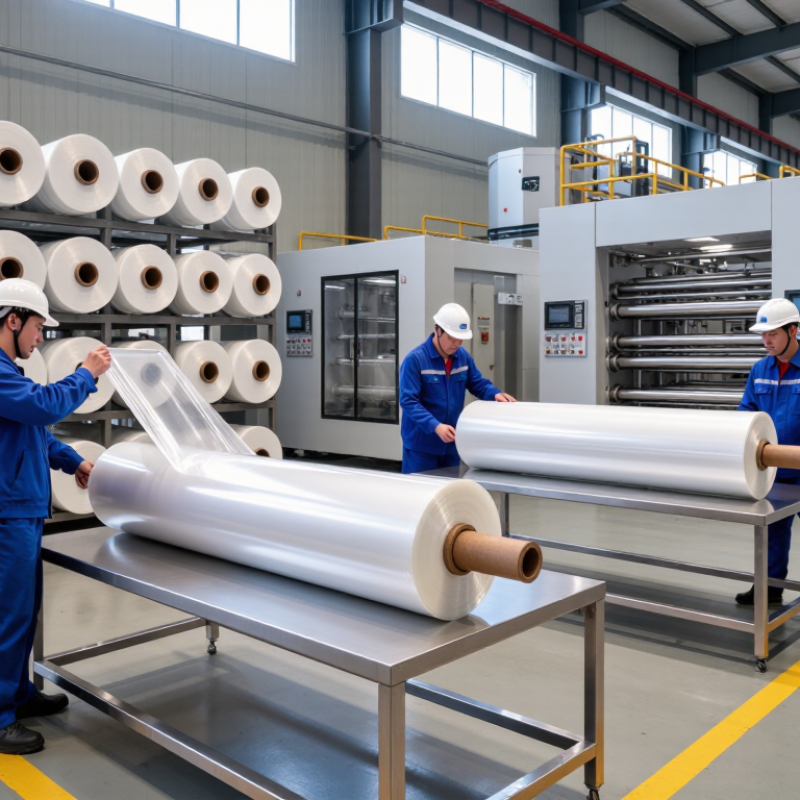
In a typical blown-film process, resin pellets are fed into a heated extruder and melted. A rotating screw pushes the melt through a circular die, forming a tube. Air expands the tube into a bubble, which cools as rollers pull it upward. The flattened film is then wound into rolls. Small temperature changes can affect thickness and clarity.
Manufacturers may use a flat die and chill rolls instead, depending on the film’s intended use and required dimensions. Technicians check gauge, surface appearance, and roll consistency; a handheld thickness gauge can reveal uneven areas. Still, the label “HDPE film” does not specify every performance detail. Resin grade, additives, cooling, and processing conditions all matter. Small differences matter. A film suited to a sturdy liner may not work as well for a flexible package, so specifications and sample testing deserve careful attention.
| Evaluation Dimension | Factual Reference or Specification | Why It Matters | How to Verify |
|---|---|---|---|
| Material definition | High-density polyethylene (HDPE) is a polyethylene category commonly associated with a density of approximately 0.941–0.965 g/cm³. | Resin density helps distinguish HDPE from lower-density polyethylene grades and influences stiffness and other film properties. | Request the resin technical data sheet and check density using a recognized method such as ASTM D1505 or ISO 1183-1. |
| Film-making process | HDPE film is commonly made by extrusion. In blown-film extrusion, molten polymer passes through an annular die, forms a bubble, cools, and is collapsed and wound into rolls. | Process control affects film gauge consistency, roll quality, and the balance of properties in the machine and transverse directions. | Ask for a process description, quality-control records, and representative roll samples. |
| Film thickness | There is no single standard thickness for all HDPE films; the nominal gauge and allowable tolerance should be specified for each application. | Thickness affects material use, strength, stiffness, and suitability for converting or packaging operations. | Compare the agreed nominal thickness and tolerance with measured results; ASTM D6988 provides guidance for measuring plastic film thickness. |
| Tensile properties | Tensile strength and elongation depend on resin grade, film gauge, and processing conditions. Film results should be reported in both machine direction (MD) and transverse direction (TD). | Directional results help assess how the film may perform during handling, converting, and use. | Request test data with specimen direction, thickness, and test method stated. ASTM D882 is commonly used for tensile properties of thin plastic sheeting. |
| Impact resistance | Impact performance varies by formulation, thickness, and film structure; there is no universal pass value for every HDPE film application. | Impact testing can help assess resistance to puncture or sudden loading in the intended use. | Specify the required test and acceptance criteria. ASTM D1709 is a commonly used falling-dart impact test method for plastic film. |
| Melt flow rate | Melt flow rate is resin-grade dependent. For polyethylene, a commonly reported ASTM D1238 condition is 190°C with a 2.16 kg load; results must include the test condition. | This value helps describe resin flow behavior during processing, but does not by itself establish finished-film quality. | Check the resin data sheet or certificate of analysis and confirm that reported values use comparable test conditions. |
| Surface friction | Coefficient of friction (COF) depends on the film surface, additives, and test setup; a target should be set for the intended converting or packaging process. | Friction affects film feeding, stacking, and movement on packaging equipment. | Request static and kinetic COF results where relevant, with the method and test conditions identified. ASTM D1894 is a commonly used test method. |
| Roll and order specifications | Usable roll width, roll length, core dimensions, winding direction, and packaging requirements are order-specific rather than universal HDPE-film values. | Clear roll specifications reduce handling issues and help ensure compatibility with downstream equipment. | Confirm every roll dimension and tolerance in the product specification and verify them against inspection records and delivered rolls. |
| Manufacturer comparison | Meaningful supplier comparisons should use the same product specification, test methods, tolerances, and application requirements. | Comparing unlike gauges, resin grades, or test conditions can make performance claims misleading. | Compare documented technical data, sample results, quality certificates, production controls, and order-specific inspection records rather than relying on an unsupported ranking. |
The values and methods above are general technical references, not rankings or guaranteed specifications for any particular supplier. Confirm the required limits and applicable standards for the intended product and market.