

China Best Battery Manufacturers for Global Buyers
Choosing the right China Battery Manufacturers can shape product safety, delivery reliability, and long-term operating costs. Global buyers often compare more than battery prices. They examine cell chemistry, production capacity, quality controls, testing records, and after-sales support. A factory may offer lithium-ion, LiFePO4, lead-acid, or custom battery systems. Each option suits different applications, from electric vehicles and solar storage to medical equipment and industrial tools.
Details matter. During a factory evaluation, buyers should review sample test reports, cell traceability, thermal management, and packaging quality. A reliable supplier can explain its production process clearly. It should also provide consistent specifications, realistic capacity figures, and transparent lead times. Certifications such as UN 38.3, IEC standards, and relevant regional requirements may support responsible international shipping and market entry. However, certification alone does not guarantee every shipment will perform perfectly.
Real-world evidence helps.
Ask about warranty terms, failure rates, replacement procedures, and previous export experience. Speaking with technical staff can reveal more than a polished catalog. Factory audits, video inspections, and independent testing may expose gaps before a large order begins. Some manufacturers have impressive facilities but limited communication after payment. Others may have smaller plants yet provide careful engineering support. That difference deserves attention.
This guide reviews leading Chinese battery suppliers through a practical purchasing lens. It considers product quality, customization, production strength, compliance support, and buyer feedback. No ranking is universally correct. Application requirements, budget, certification needs, and risk tolerance can change the best choice. Buyers should verify current information directly, because capabilities and policies can change. Careful comparison remains essential.
China’s Battery Manufacturing Landscape for Global Buyers
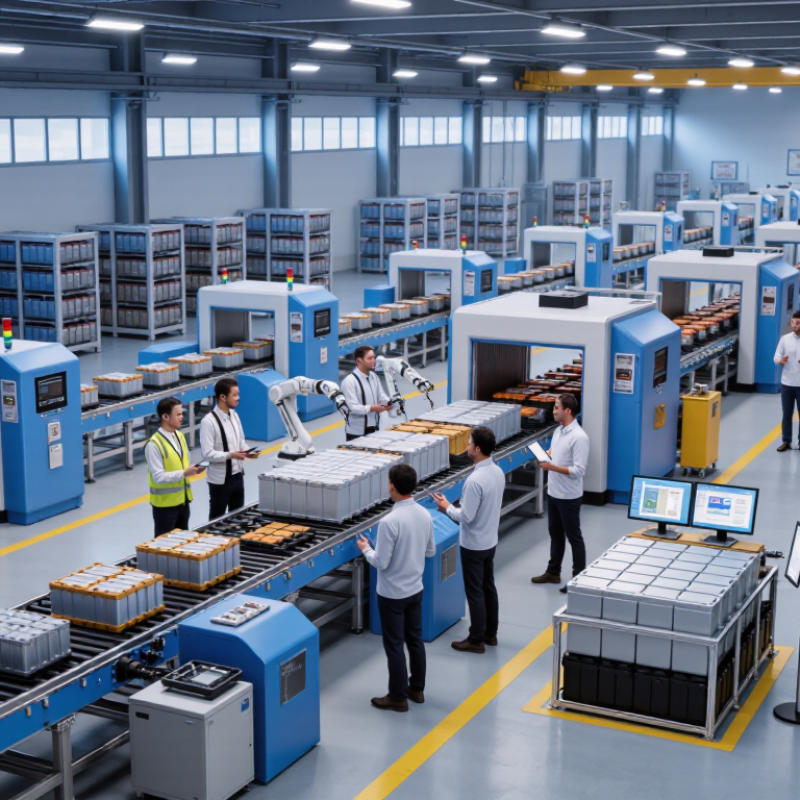
China’s battery manufacturing landscape is broad, layered, and highly export-oriented. The International Energy Agency reported in 2024 that China held nearly 80% of global battery cell manufacturing capacity. It also supplied most of the world’s cathode and anode materials. This scale supports competitive pricing, flexible production, and shorter development cycles for global buyers.
The numbers are impressive. They are not enough. BloombergNEF’s 2024 Battery Price Survey placed the global average lithium-ion pack price at 115 US dollars per kilowatt-hour, while China’s average was lower, at about 94 dollars. Buyers should examine what creates that difference. A supplier’s factory audit should cover cell consistency, process control, thermal testing, and batch traceability. Request recent test records, not only presentation slides. Check whether production data matches independent laboratory results.
Supply-chain depth is another advantage. China has strong processing capacity for lithium, graphite, and other battery materials, according to IEA analysis. However, dependence on concentrated regions can create price and logistics risks. That point is easy to overlook. Export documentation, recycling obligations, transport rules, and changing local-content policies also require careful review. A lower quotation may reflect weaker warranty support or less transparent material sourcing. Buyers should compare total delivered cost, failure rates, and service response time. The market remains efficient, but it is not perfectly predictable.
| Buyer Evaluation Dimension | Relevant Chinese Manufacturing Capability | Typical Technical or Commercial Data | Global Buyer Relevance | Recommended Verification Points |
|---|---|---|---|---|
| Manufacturing scale | China has the world’s largest concentration of lithium-ion battery manufacturing capacity and supply-chain processing. | China accounted for approximately 80% of global battery cell manufacturing capacity in 2023, according to the International Energy Agency. | Large production ecosystems can support high-volume orders, multiple product grades, and competitive component sourcing. | Check the production site, annual capacity, equipment list, utilization rate, and whether quoted capacity is owned or outsourced. |
| Battery chemistry | Lithium iron phosphate and nickel-manganese-cobalt lithium-ion chemistries are widely produced for different applications. | LFP cells commonly offer approximately 90–180 Wh/kg; NMC cells commonly offer approximately 150–280 Wh/kg, depending on design and format. | LFP is generally preferred for cost, thermal stability, and cycle life; NMC is often selected where higher energy density and lower pack weight are priorities. | Request cell-level test reports, chemistry confirmation, energy-density calculations, and independent capacity testing. |
| Cell formats | Prismatic, cylindrical, and pouch formats are available across China’s industrial battery supply chain. | Prismatic cells simplify module packaging; cylindrical cells support automated production; pouch cells can provide efficient space utilization. | Format selection affects pack design, thermal management, serviceability, tooling cost, and minimum order quantity. | Confirm cell dimensions, terminal design, expansion allowance, enclosure requirements, and end-of-life replacement procedure. |
| Cycle life | Cycle-life offerings vary substantially by chemistry, depth of discharge, temperature, charging rate, and end-of-life definition. | Typical commercial LFP products may be specified at approximately 2,000–6,000 cycles; NMC products commonly range from approximately 1,000–3,000 cycles under defined test conditions. | Long cycle life is important for energy storage, commercial vehicles, material-handling equipment, and high-utilization fleets. | Require the test temperature, charge/discharge rate, depth of discharge, retention threshold, and full test protocol. |
| Energy-storage suitability | China supplies battery systems for residential, commercial, industrial, utility-scale, and renewable-energy applications. | Common system configurations include low-voltage residential systems and high-voltage commercial or utility systems, with capacities ranging from several kWh to multi-MWh installations. | Buyers can source both standardized battery cabinets and customized containerized systems from the same broader supply ecosystem. | Review round-trip efficiency, usable capacity, auxiliary consumption, warranty throughput, fire protection, and grid-connection requirements. |
| Electric-vehicle applications | Chinese production covers cells, modules, battery packs, battery-management systems, and thermal-management components for electric mobility. | Passenger-vehicle and commercial-vehicle packs are commonly engineered around nominal system voltages from approximately 300 V to 1,000 V. | China’s integrated supply chain can support both standard battery packs and platform-specific designs for buses, trucks, special-purpose vehicles, and passenger vehicles. | Verify pack-level crash safety, ingress protection, thermal propagation testing, software ownership, and vehicle homologation requirements. |
| Battery-management systems | Available solutions range from basic protection boards to centralized, distributed, and cloud-connected BMS architectures. | Typical BMS functions include cell voltage monitoring, temperature monitoring, current measurement, balancing, state-of-charge estimation, and fault protection. | A suitable BMS improves safety, usable capacity, diagnostics, and integration with inverters or vehicle controllers. | Confirm communication protocols such as CAN, RS485, or Ethernet; data access rights; firmware update procedures; and cybersecurity controls. |
| Safety and compliance | Export-oriented suppliers commonly prepare documentation for international transport, product safety, and application-specific certification. | Frequently relevant requirements include UN 38.3 for transport testing, IEC 62619 for industrial lithium secondary batteries, and IEC 62133-2 for portable sealed secondary lithium cells. | Proper certification reduces customs delays, insurance concerns, integration risk, and market-entry problems. | Confirm certificate scope, model number, manufacturing site, report validity, test laboratory, and whether certification applies to the complete system or only the cell. |
| Quality-control system | Established factories may use incoming-material inspection, automated production monitoring, end-of-line testing, and batch traceability. | Important controls include cell matching, internal-resistance testing, insulation testing, capacity grading, leak testing, and pack-level functional testing. | Consistent quality is essential when buyers require repeat deliveries across multiple production batches. | Request ISO 9001 evidence, quality-control plans, defect-rate data, sample inspection records, and serial-number traceability. |
| Export and logistics readiness | China has extensive ports, freight-forwarding services, dangerous-goods handling capabilities, and battery-export experience. | Lithium batteries are classified as dangerous goods for transport and require applicable packaging, labeling, documentation, and testing records. | Experienced export operations can improve delivery predictability and reduce documentation errors. | Clarify Incoterms, shipping mode, dangerous-goods documents, packaging design, insurance responsibility, customs classification, and destination-country rules. |
| Customization capability | Chinese battery factories commonly support customized voltage, capacity, enclosure, connector, communication, thermal-management, and mounting solutions. | Customization normally affects tooling, engineering fees, minimum order quantity, validation time, and warranty terms. | Customization is valuable for industrial equipment, specialty vehicles, robotics, marine systems, and backup-power products. | Use a signed technical specification, approved drawings, golden samples, change-control procedures, and defined acceptance criteria. |
| Warranty and after-sales support | Warranty structures differ by product type, operating conditions, annual throughput, and application environment. | Commercial battery warranties are often defined by a period, cycle count, throughput, or remaining-capacity threshold rather than time alone. | Clear warranty terms are particularly important for distributed systems, fleet applications, and projects requiring long-term performance guarantees. | Check warranty exclusions, service response time, replacement responsibilities, remote diagnosis, spare-parts availability, and claim procedures. |
| Cost structure | Pricing is influenced by lithium and other raw-material costs, chemistry, cell format, order volume, certification, customization, packaging, and freight. | Cell pricing, battery-pack pricing, and complete energy-storage-system pricing should be evaluated separately because integration costs can be substantial. | Comparing total cost of ownership is more meaningful than comparing the initial battery quotation alone. | Compare usable kWh, delivered cost, efficiency, cycle life, warranty throughput, installation cost, and expected replacement cost. |
| Data basis: Typical technical ranges are application-dependent and must be confirmed through product specifications and independent testing. Market context is aligned with publicly available information from the International Energy Agency, IEC standards, and UN lithium-battery transport requirements. | ||||
Related Posts
-
Navigating Import Export Certifications for the Leading Battery Manufacturers
-

Unmatched Quality in Global Lithium Pro Batteries from China's Premier Manufacturer
-
What Are The Advantages of Ionic Batteries for Global Sourcing?
-
2026 Top Lithium Battery Inverter Types for Global Buyers
-
How to Harness the Advantages of Best New Battery Technology for Your Business
-
Top 10 Lithium Battery Inverters for Global Buyers Today?