

What Are the 7 Best Ionic Battery Buying Tips for Buyers?
Choosing an Ionic Battery is not just a matter of comparing prices or matching a voltage label. Battery performance affects runtime, charging, safety, and replacement costs. The market is growing quickly: the International Energy Agency’s Global EV Outlook 2024 reports that electric-car battery demand exceeded 750 GWh in 2023, about 40% higher than in 2022. That scale makes clear product information more important, not less.
For buyers, the useful details are practical. Check the chemistry, rated and usable capacity, continuous power, charging limits, operating-temperature range, and expected cycle life. Then read the warranty closely. It should explain coverage duration, capacity retention, and any conditions that could void a claim. A compact battery may fit neatly under a seat or inside a cabinet, but its dimensions alone cannot confirm that it suits the device or installation. Compatibility matters.
Safety and evidence deserve equal attention. Look for a manufacturer that publishes technical specifications, test documentation, and clear guidance for storage and charging. Where relevant, verify applicable product certifications with the issuing organization rather than relying on a logo in a listing. Compare total ownership costs, including chargers, installation, and likely replacement needs. Numbers help. Yet advertised cycle life can depend on temperature, depth of discharge, and test conditions, so comparisons are not always like-for-like. A label can still hide trade-offs. These seven buying tips offer a grounded way to ask better questions before choosing a battery—and to recognize when the available evidence is incomplete.
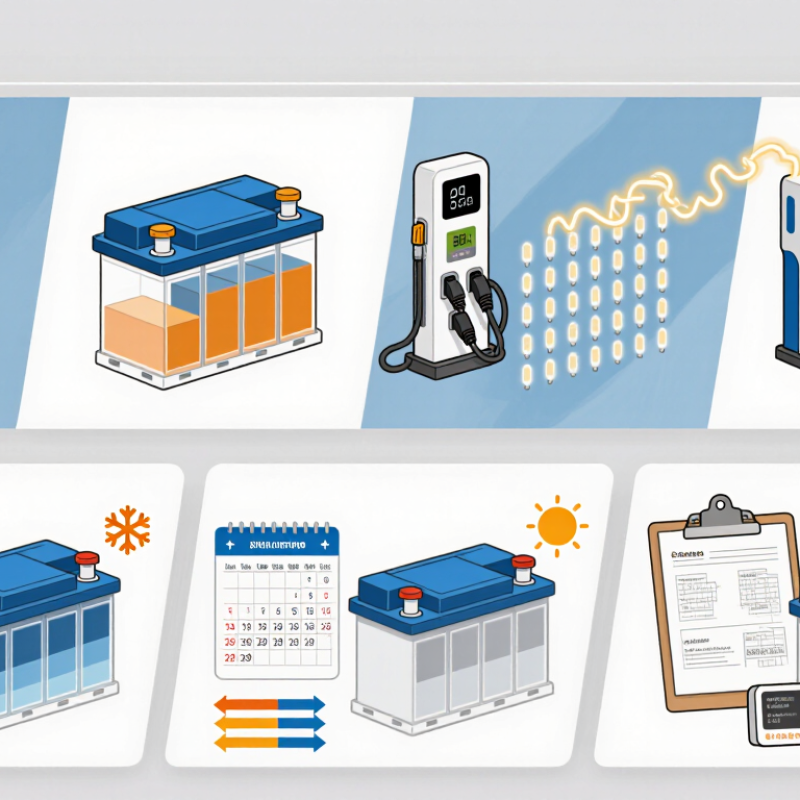
Select Chemistry by Cycle Life: LFP Batteries Can Exceed 2,000 Cycles
LFP chemistry is worth considering when replacement costs matter more than compact size. EPRI’s Electricity Storage Handbook notes that lithium-ion cycle life varies by cell design and operating conditions; LFP systems can be rated beyond 2,000 cycles. That is a useful benchmark, not a guarantee. A cycle usually means one full equivalent discharge and recharge, even when several partial cycles add up to it. The IEA’s Global EV Outlook 2024 reported that LFP supplied nearly 40% of global electric-car battery demand in 2023, showing how widely this chemistry is used.
Check what the cycle figure actually measures. Is it tested at a moderate temperature, a shallow discharge, or a gentle charge rate? Those details change the result. NREL research on battery life modeling likewise shows that temperature and operating patterns affect degradation. Ask for the test conditions and the capacity-retention threshold, often 80%, behind the quoted figure. Then compare the warranty’s years and energy throughput with your expected daily use. A garage battery cycling once a day faces about 365 cycles yearly. Heat matters. So does sitting fully charged. I would not buy on cycle count alone; the fine print is easy to overlook, and sometimes the “2,000-cycle” number feels more certain than the evidence warrants.
What Are the 7 Best Ionic Battery Buying Tips for Buyers? — Select Chemistry by Cycle Life: LFP Batteries Can Exceed 2,000 Cycles
| # | Buying Tip | What to Check | Useful Data or Guidance | Why It Matters |
|---|---|---|---|---|
| 1 | Choose the right battery chemistry | Compare lithium iron phosphate (LFP) with nickel-based lithium-ion chemistries such as NMC. | LFP cells commonly offer long cycle life and strong thermal stability. Many LFP products are rated for more than 2,000 cycles under specified test conditions; actual life varies by design and use. | Chemistry affects service life, energy density, operating limits, and cost. Match the chemistry to the application rather than relying on a single headline figure. |
| 2 | Read the cycle-life test conditions | Check the stated depth of discharge (DoD), charge and discharge rate, temperature, and end-of-life capacity threshold. | A cycle-life claim is meaningful only with its test conditions. For example, a rating may define end of life as reaching 80% of initial capacity; this is not the same as a guarantee of a fixed number of years. | Different test methods can produce very different cycle counts, so compare like with like. |
| 3 | Calculate usable capacity and DoD | Compare nominal capacity in kWh or Ah with the manufacturer’s recommended usable capacity and DoD. | Usable energy depends on the permitted DoD, system settings, temperature, and conversion losses. Avoid assuming that the full nominal capacity is available for every application. | A suitable usable-capacity estimate helps prevent undersizing and can support longer battery life. |
| 4 | Verify voltage compatibility | Match the battery’s nominal voltage and operating-voltage range to the inverter, charger, or equipment. | Common system classes include 12 V, 24 V, and 48 V nominal configurations, but their actual operating voltages vary by chemistry and product design. | A voltage mismatch can prevent proper operation or cause equipment faults. Confirm compatibility in the manuals for all connected components. |
| 5 | Check the BMS and current limits | Review the battery management system (BMS), continuous and peak charge/discharge current, and available communication interfaces. | The BMS typically monitors cell voltage and temperature and can disconnect the battery if operating limits are exceeded. Current ratings and supported communications are product-specific. | Correct limits and system communication help protect the battery and ensure it works with the charger or inverter. |
| 6 | Confirm the operating temperature range | Check the permitted charging and discharging temperatures, including any low-temperature charging protection. | Many lithium-ion batteries restrict charging below freezing unless they have suitable controls or heating. Follow the product’s stated temperature limits; they vary by model. | Operating outside specified limits can reduce performance and may damage cells or trigger protective shutdowns. |
| 7 | Review warranty, safety, and installation requirements | Read the warranty conditions, installation instructions, applicable safety certifications, and any required ventilation or enclosure guidance. | Warranty coverage may depend on installation, storage, temperature, usage, and registration requirements. Verify certifications against the rules and standards relevant to your location and application. | Clear documentation helps you assess support, installation suitability, and the conditions needed to maintain coverage. |
Note: Cycle life and capacity figures are product- and test-condition-dependent. Always use the specific manufacturer’s datasheet and installation manual when comparing batteries or designing a system.
Related Posts
-
10 Best Lithium Ion Battery Suppliers for Global Buyers?
-

Why Choose a Lithium Ion Battery Pack for Your Needs?
-
Future Trends in Solar Lithium Battery Technology by 2025 and Its Advantages for Renewable Energy Solutions
-

10 Best Battery Storage Systems for Global Buyers
-

How to Choose the Best Solar Lithium Battery?
-

China Best Battery Manufacturers for Global Buyers